 Inniskeen, as it is now called, is situated on the Monaghan /Louth border. It is mentioned in the Annals of the Four Masters – “Combustes Maeldun in Insula Caoin”, a local chieftain was burned to death on the local island of Inis Caoin on the river Fane – under the date 636 AD.
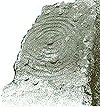
This territory had been inhabited for centuries before this time The Late Stone Age/Early Bronze people left us their inscriptions on large boulders of rock in nearby townlands. The Megalithic people -so called because the culture is characterised by the use of large stones – spread westward from the middle east about 3000 BC, with their farming methods and culture.
The principal relics these ancient people left with us are the huge monuments which they erected to honour their dead. One such monument overlooked over the Fane river at Inis Caoin and is now called the mound or motte. These monuments would be both focal points for the community that built them and act as signals to outsiders showing that the group had traditional rights to the land, e.g. “we can use these lands, for look here are our ancestors”. A flint arrow head, was discovered in the river Fane near Inis Caoin and is now in the National Museum in Dublin, where it has been dated 2000 BC.
 About this time the Celts began to arrive and quickly became the dominant race, building ring forts or raths and crannogs on lakes and rivers. Inis Caoin “the pleasant island” was a stockade dwelling place for local chieftain, Maelduin, who was converted to Chrisanity by Daig O’Carroll who was a student and apprentice with Saint Ciaran in Clonmacnoise. He also studied in Bangor and Devenish island where his uncle had a monastery on Lough Erne. Daig became a celebrated artificer and quickly established a monastery on Inis Caoin. Built totally of timber, Saint Daig’s monastery became the centre of religion, trades, milling and farming.
“Thrice fifty bells, victorious deed
With one hundred strong crosiers,
With sixty perfect gospels,
By the hand of Daig alone”
Saint Daig died 586 AD. The sixth to the ninth centuries are commonly designed as “The Golden Age”, an age which was harshly, if gradually terminated by the Viking raids which bedeviled Irish monasteries. A monk penned a poem:
Bitter is the wind tonight, it tosses the ocean white hair, T
onight I fear not the fury of the north men
Cursing on the Irish Sea
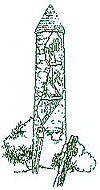 Inis Caoin was attacked and burned by Viking invaders in 789 AD. An impetus towards rebuilding with stone resulted in the construction of a round tower as a combined belfry and refuge. The entrance to the tower was set high above the ground and at the sound of the alarm from the belfry above, those seeking safely would mount rapidly, pulling their ladder up after them.
The twelfth century was a period of transition and change. The three changes to effect Inis Caoin were:
1. The arrival of the new Augustinian order of monks to the new Saint Mary’s Abbey at Louth
2. The re-organising of the Church into dioceses with bishops, deaneries and parishes which began at the Synod of Rathbreasail, Co. Tipperary in 1111 AD and was completed at the Synod of Kells, Co. Meath in 1152 AD.
3. Followed by the Anglo-Norman conquest in 1196AD
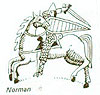
The Norman knights, led by John De Courcy, realised the strategic importance of the area and the Monastic site. They constructed a motte on top of and around the stone-age burial chamber. The motte was crowned by a stockade, with a fortified bailey or courtyard at the base.At the date 1178 AD the Annals of the Four Masters records the devastation by the Normans, of Machaire Conaill – the plain in which Inis-Caoin stands.
 Through the middle ages and down to the suppression of the monasteries, the Augustinians of St. Mary’s Abbey at Louth, were the pastors of the new parish of Inis-Caoin. The people lived in scattered towns or cabins built in formless clusters, namely, Candlefort, Drumass, Mullaghinsha, Blackshanquogh (Shancoduff) and Blackstaff.
In 1509 AD copies of English Maps and surveys Inis-Caoin was anglicised as “Enniskeen or Iniskene” and the are noted as church land, belonging to the primate of Armagh, who at that time was in dispute with the Earl of Essex as to the ownership of townlands south west of the river Fane. The territory was then called Clancarroll, part of the Barony of Farney.
In the late 17th century these lands became the property of Viscount Weymouth, Lord Bath. Thus they remained until the Bath Estate was sold to the tenants in the 1880’s.